Digital transparency: the new currency of the client relationship in logistics
In logistics, excellence is no longer just about storing and shipping well. Shippers now expect continuous proof of service quality, just as they do in e-commerce: information on demand, responsiveness and the ability to manage operations without friction. As Laurent Ricaux, Deputy Managing Director of Prévoté Logistique, puts it: "Today, it's no longer acceptable for a client not to know what's happening at their provider."
That expectation has a direct consequence: the digital client relationship becomes a competitive lever, not just an IT topic. And when digitalization is well designed, it does more than "show" things: it optimizes, cuts the admin workload and makes operational execution more reliable.
"Client portal": from visibility to collaboration
The idea of a "client portal" has come a long way. At first, it was mostly about visibility: seeing stock, orders and progress. Today, clients ask for more: collaboration.
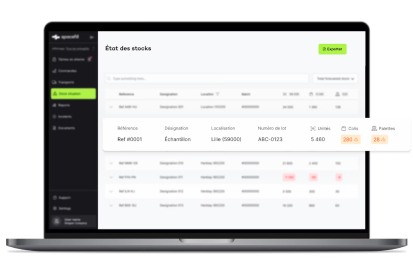
One figure stands out from the discussion: in three years, the share of RFPs requiring a digital portal has gone from one in two to nearly 60%. The vocabulary has changed, because clients no longer just want to look things up. As the discussion summed it up: "A client portal means collaboration: being able to change orders, put them on hold, recall them, set rules, retrieve documents, automate, connect systems."
In other words, the portal becomes a daily working interface. It puts the provider and the client on the same "source of truth", which reduces misunderstandings and speeds up problem solving.
To give your clients access to their orders, stock and incidents under your own brand, see our client portal for 3PLs.
The business impact: standing out and staying in more RFPs
Digital isn't only an internal improvement: it's also a sales lever. Laurent Ricaux explains how the digital approach improved Prévoté's ability to win and to stay in the race.
Two indicators stand out:
- 40% more often through to the second round of RFPs
- A higher win rate, rising from about 15% to 25%
The "why" matters: in the past, providers struggled to make their technology pitch tangible. In RFP responses, the slides stayed too generic: "Now, with the portal, and to some extent the integrations… we can show something more concrete. The technology side comes across more clearly."
Deployment speed makes a difference too. Laurent gives a practical example: connecting and onboarding a client used to be long and expensive. With connectors designed to be "plug and play", it goes from about three months to about one month, and sometimes one week for standard cases.
That acceleration works in two ways:
- it reduces the risk the client perceives,
- it helps size the offer and the project timeline more accurately.
Admin gains: less data entry, fewer errors, more capacity
For a 3PL, the most visible benefit is often admin time. In Prévoté's experience, the changes affected several types of clients: small, mid-sized, and more "audited / integrated" accounts.
Before digitalization, a large part of the business ran on semi-manual entry: confirmation emails, Excel files, extracting and transferring data. A classic pattern: the client sends, the provider keys it in.
Once the collaborative portal and the integrations were in place, less digitally mature clients started entering orders directly in the portal, with structuring and routing automated. Laurent describes the result: "We got it down to one minute." Admin processing per order went from 4 to 5 minutes to about one minute.
Across the business, Laurent sums up the result in Prévoté's customer story: "Spacefill not only centralized the flows but also enabled 90% automation of order processing and reduced related administrative costs by 75%."
That is no small detail. Absorbing rising volumes with zero additional admin staff in three years means the organization handles growth without hiring at the same pace.
The quality effect matters just as much: removing manual entry reduces errors. Laurent notes: "I don't have the numbers off the top of my head, but it's a reality. And I'd almost say that even if an error exists, the problem now sits with the client." In practice, the issue isn't only the data entry itself: it's the knock-on effects (invoicing, data consistency, disputes).
Turning data-entry operators into client-facing admin assistants
Digitalization also changes jobs. When repetitive tasks disappear, value moves elsewhere. Laurent puts it clearly: the teams who used to do basic data entry are moving toward client relationship and support work.
"It moves people up the value chain a bit… it's not quite the same job." Change management then becomes a key skill. A tool, however good, doesn't automatically get 100% adoption.
The same reality shows up in the discussion on incidents and ticketing: some clients use the feature, others less so. The issue isn't technical capability, but aligning practices, data sources and how knowledge is captured. Laurent sums up one scaling challenge: harmonizing how incidents are handled when they come in through several channels (email, incident form, phone calls) without creating extra work.
"Plug and play", but not "zero custom": the real deployment hurdle
The experience is a reminder of one rule: the plug-and-play promise reduces friction, but logistics reality stays specific (serial numbers, special cases, repurposed fields, particular business rules).
The main point raised: "We build plug-and-play solutions, but there's always something that isn't covered." That can create perceived risk (is it a blocker?), but the approach described is to configure the platform and fill the gaps smartly.
Balance is still needed. Laurent warns against over-customization: too many specifics increase maintenance, dependence on a few in-house experts and backup complexity. The strategy he describes: standardize 80% and handle 20% as differentiation.
It's a directly applicable message: lasting performance comes as much from standardization as from covering special cases.
Going paperless: from documents to statuses, a smoother experience
Beyond orders and stock, digital collaboration extends to documents. The testimonial stresses the importance of digital transfer: electronic and paper delivery notes, CMR consignment notes, related documents and shipping confirmations.
The result: fewer manual admin updates, and execution that becomes "audited" rather than "declared". In logistics, that reduces not only the workload but also the grey areas that trigger tension in client business reviews.
Subscriptions rather than one-off projects: how to fund the ROI
The question always comes back: how do you fund IT without making clients pay "for nothing"? Two answers emerge:
- For existing clients, it was hard to explain "it's better, and on top of that you have to pay." Laurent therefore absorbed part of the value through the extra productivity.
- For new clients, a subscription model becomes acceptable, because clients are already used to setup fees and service-based pricing.
In the example shared, the "basic / standard / premium" subscription tiers match different levels of integration and value. The price varies with the options (connection, dock booking, automations, etc.). The point isn't only financial: it's also a way to standardize and scale the solution and make it accessible.
What's next: from service provider to driver of logistics decisions
The most strategic shift concerns the 3PL's role in the ecosystem. The underlying logic: as the client delegates more, the provider becomes a success factor and a decision-making partner.
Laurent describes a key ambition: "Offer the best transport solution… with engineering behind the choice of transport network depending on the quality of the order… and eventually, offer an end-to-end logistics solution."
The levers mentioned include decision support, prediction and anticipation, especially for:
- inventory management (speeding up stock rotation to free capacity for value-added services),
- quality management (orders, addresses, consistency),
- recommendations at client business reviews.
Behind it all lies one objective: rely less on late reports and act earlier. Laurent's point, in essence: the stress that comes "after the fact" has to become a system that works "before the fact".
Definition: what is a "digital control tower" in logistics?
A digital control tower lets you track, correlate and steer logistics execution in time to act, through:
- a portal for key data (orders, stock, documents),
- connectors (API/EDI) between systems,
- statuses and traceability for every flow,
- and alert mechanisms (failed transfers, SLAs, incidents).
The testimonial shows that this kind of "steering" has become a selection criterion in RFPs, not a nice-to-have.
Conclusion: digitalization isn't a tool, it's a strategy for trust and efficiency
What stands out from this experience is a clear trajectory: digital transparency makes the relationship more reliable, cuts admin work, improves quality and strengthens the sales pitch. The figures shared (faster onboarding, more second-round RFP shortlists, admin time per order cut sharply) show that the ROI can be real, as long as you think about adoption, standardization and change management.
Above all, technology acts as a catalyst: it changes how the provider is perceived, gives it a leading role and prepares the ground for decision support and intelligent automation. The overall message: tomorrow, clients will refocus on their core business and expect their 3PL to orchestrate, anticipate and advise.
If you want to get started, the most concrete first step remains this one: align your client experience with continuous transparency, then build the automations that make that transparency useful, measurable and scalable.