Orchestrating your logistics, in brief
Orchestrating your logistics means steering, in real time, the journey of every order across all your sales channels, warehouses and 3PL providers, so that it ships from the right place, at the right time, via the right carrier, with a delivery promise you can keep. It rests on four layers: order capture, a unified stock view, intelligent allocation and the customer promise. The goal is not to replace your WMS or ERP, but to add an order orchestration layer on top of what you already run.
In 2026, e-commerce logistics is no longer a single-warehouse affair. An order can arrive from your storefront, a marketplace, a B2B channel or a store, and need to ship from one of your in-house warehouses or one of your 3PLs. The real question for logistics teams is no longer "where to store", but "how to coordinate this flow without losing control or visibility". This article explains what orchestration covers, why it has become critical, how to diagnose poorly orchestrated logistics, and where to start to regain control without replacing everything.
What does orchestrating your logistics actually mean?
Logistics orchestration is the control layer that decides, in real time, how each order moves through your chain: from capture at checkout to delivery or return, including allocation to the right logistics node, picking and tracking.
It should be distinguished from two neighboring building blocks it is often confused with:
- The WMS (Warehouse Management System) runs what happens inside a warehouse: receiving, putaway, picking, shipping.
- The ERP centralizes finance, procurement and invoicing.
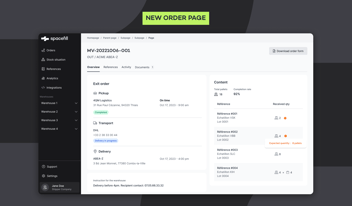
Orchestration works above the warehouses and channels. It is the control tower: it replaces neither your provider's WMS nor your ERP, it makes them talk to each other so that an order placed on Shopify, on a marketplace or via B2B EDI is allocated, shipped and tracked without manual entry. This is exactly the logic of a 3PL collaboration platform.
Why orchestration has become critical in 2026
The cost of unorchestrated logistics is measurable, and it is massive. According to IHL Group, stockouts and overstocks (what the industry calls inventory distortion) cost the global retail sector around $1.73 trillion per year, or 6.5% of revenue, and supply chain disruption is the single largest driver at $301 billion. In other words, the money is not lost inside the warehouse, it is lost in the coordination between nodes.
The same problem shows up downstream, on returns. The National Retail Federation puts US returns at $890 billion in 2024, with an e-commerce return rate above 20%. Without orchestration, every return takes weeks to become sellable stock again, which ties up capital and distorts displayed availability.
Phantom stockouts, overstocks, slow returns: these are three symptoms of the same cause, a flow poorly coordinated across channels, stock and providers. Orchestration tackles the cause, not the symptoms.
The 4 layers of well-orchestrated logistics
Well-orchestrated logistics rests on four layers that build on each other. A single failing layer breaks the whole mechanism.
| Layer |
What it does |
Risk if missing |
| 1. Order capture |
Centralizes all orders (site, marketplaces, B2B, EDI, stores) in a single repository |
Manual re-keying, lost files, errors |
| 2. Unified stock view |
Shows real-time availability across all nodes (warehouses, 3PLs, stores, in-transit) |
Oversells, phantom stockouts, painful month-end close |
| 3. Allocation and routing |
Decides which order ships from which node based on stock, cost, lead time, SLA |
Manual arbitration, shipping overspend, missed SLAs |
| 4. Customer promise and execution |
Calculates the delivery date at checkout (ATP), tracks execution and returns |
Generic promise, surge in WISMO calls |
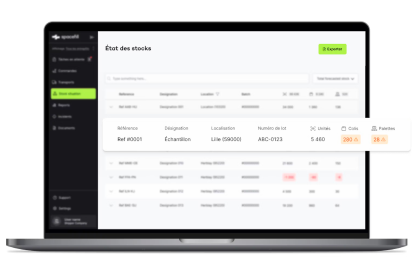
In practice, layer 2 relies on an inventory management system that consolidates availability, and layer 4 on the ability to deliver a precise promise at checkout. Both depend on reliable, real-time stock data: the foundation of the whole structure.
The 5 symptoms of poorly orchestrated logistics
Run the diagnostic. If you recognize three signals or more, orchestration is your priority project.
- Your teams capture or reconcile orders by hand across channels, marketplaces and the ERP. Several days a month go into this.
- You suffer oversells or phantom stockouts: stock sold that does not exist, or the opposite.
- The "which order ships from which warehouse" decision is made manually, or with a rigid hard-coded rule.
- Your customers receive a generic promise ("ships within 5 days"), and your "where is my order" call rate climbs.
- Every new channel, marketplace or country triggers a long, costly integration project.
The 4 maturity levels of orchestration
Not every organization starts from the same point. Placing your level helps you aim for the next step rather than rebuild everything at once.
| Level |
How it works |
Main limitation |
| 0. Manual |
Excel, emails, copy-paste between 3PL portals |
Does not scale, constant errors |
| 1. File-connected |
Batch syncs (often once a night) |
Delayed data, intraday stock gaps |
| 2. Centralized |
An OMS captures orders and applies allocation rules |
Stock and 3PLs not yet unified in real time |
| 3. Real-time orchestrated |
Unified stock, automatic allocation, promise at checkout, connected 3PLs |
Requires an orchestration layer plugged into the existing stack |
The goal is not necessarily to reach level 3 on every flow overnight, but to move out of levels 0 and 1, where the losses described above are concentrated.
Where to start: a 4-step roadmap
The classic mistake is to rebuild everything at once. Orchestration is built in stages, starting with data.
Step 1: map the flows and nodes. List your sales channels, warehouses, 3PLs and their WMS, and your carriers. Identify where data is lost and where manual work concentrates.
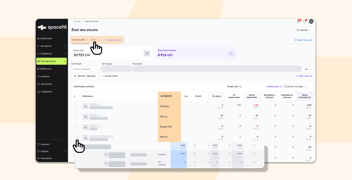
Step 2: unify stock data. Create a single source of truth for stock, in real time, across all nodes. This is the foundation: without it, neither allocation nor the promise is reliable.
Step 3: centralize capture and automate allocation. Funnel every order into a single repository, then formalize your allocation rules and automate them with a no-code rules engine.
Step 4: activate the delivery promise and measure. Display a precise date at checkout, track execution, and steer with indicators (service rate, lead time, cost per order, error rate).
Orchestrating without replacing everything: the hybrid approach
The most expensive trap is to believe that orchestrating requires replacing your WMS, your ERP or changing 3PL. It does not, and that belief is what sinks most projects: too heavy, too long, too risky.
The right approach is an orchestration layer that plugs into the existing stack. This is Spacefill's positioning: a hybrid OMS that combines order orchestration, a real-time unified stock view and an activatable 3PL network, and that connects to your providers' existing WMS without forcing a migration, through 3PL Connect (50+ native connectors, the rest covered by API or EDI).
Concretely, this lets you unify multi-channel capture, automate routing with a no-code rules engine, calculate a dynamic delivery promise at checkout, share a common view with your 3PLs, and rely on AI agents for anomaly detection and automated data entry. The gains Spacefill measures across its clients: +12% checkout conversion, -67% "where is my order" calls, -80% manual tasks, -50% picking errors, with a deployment in 6 to 12 weeks rather than months.
Conclusion
Orchestrating your logistics is not one more IT project: it is regaining control of a flow that has become multi-channel, multi-warehouse and multi-3PL, exactly where the losses now concentrate ($1.73 trillion of inventory distortion per year according to IHL Group). The right method starts with data, a unified and reliable stock view, then moves up to automated allocation and the customer promise, all without replacing the existing stack. This is precisely what a hybrid orchestration layer like Spacefill enables.
Want to see how to orchestrate your e-commerce logistics on your current stack, without replacing everything? Book a Spacefill demo for a walkthrough on your specific use case.
FAQ
Are logistics orchestration and an OMS the same thing?
The OMS (Order Management System) is the tool that performs order orchestration. Logistics orchestration is the broader approach: it includes the OMS, but also the unified stock view, 3PL management and the customer promise. Think of the OMS as the engine of orchestration.
Do I have to replace my WMS or ERP to orchestrate my logistics?
No. A good orchestration layer plugs into your providers' WMS and your ERP without replacing them. That is actually the condition for the project to succeed quickly and without risk.
How long does it take to set up logistics orchestration?
It depends on the complexity of your stack, but a modern platform like Spacefill deploys in 6 to 12 weeks as a standard engagement, and 4 to 6 months for a multi-country rollout, versus 6 to 18 months for traditional enterprise solutions.
Is my company big enough to orchestrate its logistics?
Orchestration becomes relevant as soon as you move beyond a single channel and a single warehouse: several sales channels, several warehouses, or one or more 3PLs. Below that, your CMS native features are often enough.
How much does poorly orchestrated logistics cost?
At market level, IHL Group estimates inventory distortion (stockouts and overstocks) at around $1.73 trillion per year, or 6.5% of global retail revenue. At a single company level, it translates into lost sales, capital tied up in overstock and unoptimized shipping costs.
Where should I start if my budget is limited?
With stock data. A single, real-time source of truth for stock is the foundation that makes everything else reliable (allocation, promise, steering). It is the investment with the best impact-to-effort ratio.