Outsourced inventory in 2026: from warehouse to network orchestration
Outsourcing inventory to a third-party logistics provider (3PL) has become a standard for e-commerce merchants who want to scale without weighing down their organization. More than 60% of mid-market DTC brands in Europe now work with at least one 3PL, and nearly a third use several in parallel for reasons of geographic coverage, specialization, or redundancy.
This rise changes the very nature of inventory management. It is no longer just about running an in-house warehouse: it is about orchestrating a network of external players, each with its own WMS, processes, and SLAs. Without a method, it becomes the perfect breeding ground for inventory discrepancies, broken delivery promises, and customer disputes. With a method, it becomes a massive scalability lever.
This guide walks through the outsourcing models, the specific challenges, the operational process to put in place, the KPIs to track, and the tools you need.
Why outsource your inventory
Three main drivers push merchants toward outsourcing.
Geographic scalability. Serving Europe or the world from a single domestic warehouse generates high shipping costs and uncompetitive lead times. Outsourcing to regional 3PLs (one in France, one in Germany, one in the UK, one in the US) cuts delivery times and logistics costs by a factor of two or three.
Focus on the core business. Investing in a warehouse, hiring operators, managing security, insurance, and maintenance is a profession in itself. Many DTC brands prefer to focus their resources on product, marketing, and brand, and delegate logistics operations to specialists.
Flexibility in the face of volatility. A 3PL scales its resources with your activity. During a Black Friday peak or a viral launch, it absorbs the surge. In the off-season, you only pay for what you use. This elasticity is impossible to achieve with an in-house warehouse.
The 4 outsourcing models
Not all models are equal, and each has its own management challenges.
Model 1: single national 3PL
A single provider covers your domestic fulfillment. The simplest to manage, but the most geographically restrictive. Suited to merchants getting started or focused on a single market.
Main challenge: total dependence on the provider. If their WMS runs into a problem, you are stuck.
Model 2: geographic multi-3PL
Several providers, each covering a zone (FR, DE, UK, US). The standard for DTC brands scaling in Europe or internationally.
Main challenge: orchestration. Which order goes to which warehouse? Based on which rule (customer proximity, available stock, daily capacity, cost)? Without an orchestration platform, these arbitrations are made manually and create errors.
Model 3: specialized multi-3PL
One provider for standard B2C, another for B2B (pallets, specific packaging), another for retail (store replenishment). Suited to omnichannel brands or distributors with multiple business lines.
Main challenge: inventory consistency. Stock is sometimes siloed by model, which creates over-stock and simultaneous shortages on SKUs that could be pooled.
Model 4: hybrid retail plus 3PL (ship-from-store)
Inventory is shared between physical stores (for ship-from-store and click and collect) and one or more 3PLs for e-commerce. A model that is increasingly common among omnichannel retailers.
Main challenge: real-time arbitration between stores and 3PLs, with different constraints (limited store capacity, priority for the in-store customer).
The core challenge: visibility and orchestration
Whether you run model 1 or model 4, the common challenge is the same: having a unified view of inventory at all times, and orchestrating orders to the right logistics node in real time.
Without this orchestration layer, you fall into three classic traps.
The "theoretical" stock trap. You see a stock level on your CMS that does not reflect the physical reality at the 3PL. A stockout on the provider side shows up 24 to 48 hours late on your site, which generates orders you can no longer fulfill.
The sub-optimal fulfillment trap. Without automatic arbitration, orders ship from the first warehouse that "sees" the order, not from the closest to the customer or the cheapest. The result: shipping costs 15% to 25% above optimal.
The operational blind-spot trap. Without a dashboard shared with your providers, you discover incidents (delays, breakage, inventory discrepancies) through customer support, not upstream. You manage reactively instead of proactively.
Operational process to manage outsourced inventory well
Five steps to put in place from the start.
Step 1: frame the partnership with the 3PL
A solid 3PL partnership rests on a clear contract and measurable SLAs.
Define contractual KPIs: picking accuracy rate, error rate, processing time (cut-off), accepted return rate, breakage rate. Set minimum thresholds and penalties in case of sustained drift.
Frame the standard processes: goods receipt, quality control, putaway, picking, packing, shipping, returns, cycle counts. Document these processes to align your teams with the provider's.
Anticipate the exit: what happens if you want to leave this 3PL? How long to recover your stock? How long to recover your historical data? This clause is often forgotten and costs a lot during a transition.
Step 2: connect your stack to the provider's WMS
This is the most technical and most structuring point. Three options.
Option A: native integration via the 3PL's WMS. If your provider offers a Shopify, WooCommerce, or PrestaShop connector, you can use it. Pros: fast deployment. Cons: variable quality across WMS solutions, little customization, not suitable if you work with several 3PLs.
Option B: integration middleware. Tools like ShipStation, Shippo, or Sendcloud aggregate several connectors. Pros: marketplace coverage. Cons: little intelligent orchestration between 3PLs, dependency on the middleware.
Option C: logistics orchestration platform. This is the most mature path in 2026. Spacefill plugs into your CMS on one side (Shopify, WooCommerce, PrestaShop, Wix) and into your logistics providers' WMS on the other, without forcing a migration. It aggregates inventory, orchestrates orders based on configurable rules (proximity, stock, capacity, cost), and gives shared visibility to you and your 3PLs. More than 500 deployments in France and Germany, with references like Ravensburger, Stryker, Coca-Cola, and Eurofins.
Step 3: run day-to-day operations
Three actions to industrialize.
Replenishment. Anticipate stockouts per 3PL by combining sales, forecasts, and supply lead times. Many errors come from replenishments based on global stock when site-level stock is unbalanced.
Order allocation. Define your arbitration rules. By default, the 3PL closest to the customer. In case of stockout at that node, the next closest. During a peak, smoothing across nodes based on capacity. A solid orchestration platform lets you code these rules and adjust them.
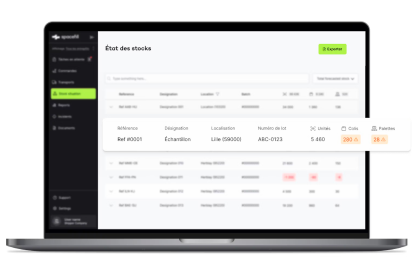
Shared visibility. A dashboard accessible to your team and your providers, with critical KPIs in real time: stock level, orders in progress, service rate, incidents. This shared visibility shifts the client-provider relationship from a blame logic to a co-piloting logic.
Step 4: handle incidents
Every 3PL will have incidents. The difference comes from how fast you detect and resolve them.
Identify anomalies upstream (delays, picking errors, breakage) rather than discovering them through customer support. A modern orchestration platform generates automatic alerts when a KPI drifts.
Define a clear resolution process: who contacts the provider, who informs the customer, who decides on a re-shipment or a refund. Without a written process, every incident becomes an improvised conversation.
Document every incident to create a continuous improvement loop. Recurring patterns point to structural issues (process, training, capacity) that need to be addressed at the source.
Step 5: reporting and continuous improvement
Monthly, run a performance review with each 3PL. KPIs hit or missed, gaps, action plans. Quarterly, run a strategic review: are volumes evolving as planned? Is the split between 3PLs still optimal? Should you add a new provider, or drop one?
Outsourcing is never set in stone. The right 3PL for 100 orders a day is not necessarily the right 3PL for 1,000 orders a day.
KPIs to track
Six KPIs cover the bulk of outsourced-inventory performance.
| KPI | Standard target | Why it matters |
|---|---|---|
| Picking accuracy rate | > 99.5% | Fewer errors, fewer returns, less customer support |
| Average processing time | < 24h after order | Delivery promise kept |
| Stockout rate per site | < 2% | Visibility on stock allocation |
| Shipping error rate | < 0.5% | Service quality |
| Logistics cost per order | To benchmark | Unit margin and price competitiveness |
| Returns processing time | < 5 business days | Customer satisfaction and stock reintegration |
Tools you need
To run an outsourced inventory operation seriously, three software building blocks are essential.
An e-commerce CMS as the source of orders (Shopify, WooCommerce, PrestaShop, Wix, Magento).
A logistics orchestration platform (Spacefill or equivalent) that aggregates inventory across the different 3PLs, orchestrates orders based on your rules, and gives shared visibility to all stakeholders. This is the critical layer that makes outsourcing scalable.
Your logistics providers' WMS (each provider runs its own). They drive physical operations in the warehouse. You don't need to replace them; you need to connect them to your orchestration layer.
Optional but useful: an ERP for financial governance, a PIM for product catalog, and a demand forecasting tool to anticipate replenishments.
Mini case study: Ravensburger
Ravensburger, a historic manufacturer of games and puzzles present in more than 70 countries, deployed Spacefill to orchestrate its pre-connected overflow network in France and Germany. The goal: secure flexible logistics capacity to absorb seasonal peaks (Christmas in particular) without investing in permanent warehouses that sit underused in the off-season.
The outcome: unified visibility on inventory across multiple logistics providers, automatic order orchestration to the right warehouse based on stock and customer zone, and operational scalability without organizational overhead. The Spacefill platform plugs into the providers' WMS without replacing them, which made it possible to deploy in just a few weeks.
Full details on the Spacefill customer page: https://spacefill.com/.
Conclusion
Managing outsourced inventory well in 2026 requires a mindset shift: from running a warehouse to orchestrating a network. Five steps structure the approach: frame the partnership, connect the stack, run day-to-day operations, handle incidents, and feed continuous improvement. Six essential KPIs let you measure performance.
The software layer that makes all of this scalable is the logistics orchestration platform. Spacefill is today the most mature solution in Europe for merchants outsourcing to one or several 3PLs, with the promise of a deployment in just a few weeks, with no replacement of existing systems on the provider side.
Already running one or more 3PLs and finding that coordination is becoming a bottleneck? Book a Spacefill demo to see how to unify your outsourced inventory, your providers, and your carriers in a single platform.
FAQ
What is the difference between a 3PL and a 4PL?
A 3PL (third-party logistics) is a provider that physically executes logistics operations (storage, picking, shipping). A 4PL (fourth-party logistics) is an orchestrator that runs several 3PLs on behalf of the shipper, without owning warehouses. Spacefill is a software platform that lets a shipper operate as its own 4PL by orchestrating its 3PLs through a software layer, without delegating logistics strategy to a third party.
How much does logistics outsourcing cost?
Costs vary by country, volume, and complexity, but typical benchmarks are: 0.5 to 2 EUR per order line for picking, 0.1 to 0.5 EUR per pallet per day for storage, plus the cost of transport. For a typical DTC merchant, total logistics cost represents 8% to 15% of revenue. An orchestration platform can cut this cost by 5% to 15% by optimizing order allocation.
How do you avoid inventory discrepancies with a 3PL?
Three best practices. First, frequent cycle counts (monthly or quarterly) with detailed reports. Second, a real-time connection between your CMS and the provider's WMS (not a daily batch). Third, an orchestration platform that automatically detects anomalies (suspicious movements, accumulated discrepancies, late entries) and surfaces them before they turn into a stockout on the site.
What order allocation rules should you put in place?
The classic rules, in decreasing priority. First rule: the 3PL closest to the customer (cost and time savings). Second: balancing across 3PLs to avoid saturating one site. Third: preference for the 3PL with the best available stock. Fourth: business-specific rules (B2B vs. B2C, order value, shipping mode). A solid orchestration platform lets you code and adjust these rules without development.
How do you manage returns in a multi-3PL model?
Ideally, each 3PL handles returns from the zone it serves. This avoids intercontinental shipping costs for products that will go back to a customer in the same geographic area. An orchestration platform centralizes visibility on returns (status, reason, product condition) and automates stock reintegration as soon as items are inspected and refurbished.
What are the classic outsourcing pitfalls?
Five pitfalls. First, underestimating the integration complexity between your CMS and the provider's WMS. Second, not defining measurable SLAs and penalties. Third, lacking shared visibility and discovering incidents downstream. Fourth, ignoring exit costs in case of a provider change. Fifth, outsourcing without an orchestration platform when working with several 3PLs, which creates operational chaos.
.jpg?width=352&name=chuttersnap-BNBA1h-NgdY-unsplash%20(1).jpg)