Understanding the challenge of multi-warehouse management
Running a multi-warehouse network is one of the most demanding challenges in supply chain management. Whether you operate owned facilities alongside 3PL providers, regional distribution centers for different markets, or a ship-from-store network, the core question is the same: how do you maintain a coherent, cost-efficient operation across sites that each have their own systems, teams, and data formats?
Companies that succeed treat their warehouses as a network, not a collection of independent sites. This guide covers the design principles, software architecture, and operational practices needed to manage multiple warehouses at scale, and explains why centralized orchestration is the layer that makes everything else work.
The Core Visibility Problem in Multi-Warehouse Operations
Most multi-warehouse failures trace back to a single root cause: distributed data that no one has consolidated.
When each warehouse runs on its own WMS and each 3PL sends reports on its own schedule, every allocation decision carries information risk. Stock levels aggregated in daily spreadsheets are already stale when decisions are made. You cannot detect a developing stockout at one site while another holds excess, and manual allocation slows down exactly when volume spikes. Solving visibility requires standardizing data exchange, defining reconciliation rules, and building processes around live information rather than scheduled exports.
Designing a Multi-Warehouse Network That Scales
Network design decisions made early have long-term consequences on cost structure, fulfillment speed, and operational resilience. The right design depends on your product mix, customer geography, volume profile, and growth trajectory.
Proximity-Based Distribution
The most direct way to reduce shipping costs and delivery times is to position stock closer to where customers are. Proximity-based design means segmenting your customer base geographically and ensuring that a meaningful portion of orders can be shipped from a site within a defined radius. This model works well for high-velocity SKUs with predictable regional demand but creates risk if forecasting is poor, as regional imbalances accumulate quickly.
Specialization by Product Type or Channel
Some networks benefit from functional specialization: one site handles bulky, slow-moving items; another manages high-rotation consumer goods; a third is configured for returns processing and refurbishment. Channel specialization follows a similar logic, with dedicated facilities for B2B EDI fulfillment, e-commerce parcel shipping, and marketplace replenishment. Specialization improves operational efficiency within each site but adds routing complexity at the network level.
Resilience Through Redundancy
A network where no single site handles more than a set percentage of total volume is more resilient to disruptions: strikes, floods, equipment failures, or carrier outages. Redundancy is not a luxury for large networks, it is a design requirement. It assumes, however, that you can reroute orders to alternative sites on short notice, which in turn requires real-time stock visibility and automated routing rules.
3PL Mix as a Capacity Strategy
Many operators combine a core of owned facilities with a variable layer of 3PL capacity that scales with demand. This limits fixed costs and provides geographic flexibility. The main challenge is integration: each 3PL introduces its own WMS, data format, and communication protocol. Without a centralized orchestration layer, a multi-3PL network produces data silos that grow harder to manage as the number of partners increases.
The Technology Stack for Multi-Warehouse Management
Three software layers need to work together for multi-warehouse operations to function efficiently. Most organizations have the first layer. Few have all three working in concert.
Warehouse Management Systems (WMS)
The WMS governs intra-site operations: receiving, putaway, pick-and-pack, cycle counting, shipping, and slot optimization. Every warehouse needs one. In a multi-site context, the WMS is not the system of record for network-level decisions; it is the source of site-level data that feeds the layers above it. The challenge is that WMS platforms vary significantly in their API accessibility and data freshness, which affects how usable their data is for real-time decision-making upstream.
Order Management Systems (OMS)
The OMS receives orders from all channels and applies routing logic to determine the fulfillment site. A well-configured OMS accounts for inventory availability, delivery windows, and carrier capabilities. However, most OMS platforms were built for catalog and channel management: their routing models struggle to incorporate real-time capacity data or the specific constraints of each 3PL partner.
Logistics Orchestration Platforms
This is the layer that is most commonly missing in growing operations. A logistics orchestration platform sits above the WMS and alongside the OMS. It connects to every site's system, aggregates inventory and operational data in real time, and acts as the single control point for allocation and routing decisions. Unlike an OMS, an orchestration platform ingests live capacity signals, exception events, and site-level performance metrics that affect routing quality. It also manages the onboarding of new sites and the standardization of data exchange across the network.
Spacefill operates at this layer: it connects to existing WMS and 3PL systems, surfaces a unified view of the network, and automates routing decisions based on rules defined by the logistics team.
Smart Order Routing: Automating the Allocation Decision
Order routing is where network design and technology intersect at operational speed. In a multi-warehouse environment, the routing decision for each order should account for at least four variables: stock availability by site, estimated shipping cost from each eligible site, processing time at each site, and any service-level commitments tied to the specific order or customer.
Manual routing works at low volumes. At scale, it introduces latency, inconsistency, and a dependency on individual expertise that creates fragility. The transition to automated routing is the single highest-leverage improvement most multi-warehouse operators can make.
Defining Routing Rules
Routing rules should be explicit, documented, and codified in the system. A typical rule set might prioritize the site with available stock that offers the lowest total delivery cost while meeting the promised delivery window. Exception rules handle cases where no single site has full stock (split shipments vs. wait for consolidation), where the primary site is over capacity, or where a specific carrier is required.
Dynamic vs. Static Routing
Static routing applies fixed rules regardless of real-time conditions. Dynamic routing adjusts allocation based on live data: queue depths, carrier rates, or stock discrepancies surfaced by the WMS. Dynamic routing delivers better outcomes but demands a reliable real-time data feed from each site. Spacefill's routing engine supports configurable rule sets that teams update without engineering involvement, with manual override available for exception cases.
Inventory Management Across Multiple Sites
Multi-site inventory management requires a different mindset than single-site operations. The goal is not just to know what you have, but to know where it is relative to where demand will come from, and to act on imbalances before they become service failures.
Unified Inventory as the Operational Foundation
A unified inventory view aggregates stock levels from all sites into a single, continuously updated record. This is not a report generated nightly; it is a live data layer that the routing engine, the customer-facing availability logic, and the replenishment system all query in real time. Building this layer requires reliable API connections to each WMS, clear data reconciliation rules, and a defined refresh frequency.
Inter-Site Transfers and Rebalancing
When one site accumulates excess stock while another approaches stockout, the network needs a mechanism to rebalance. Inter-site transfers should be triggered by policy, not by exception: automated alerts when a site's stock coverage drops below a defined threshold, combined with transfer lead time and cost data, allow proactive rebalancing that avoids costly emergency shipments and stockout events.
Demand Forecasting by Zone
Network-wide forecasts miss geographic demand patterns. A product with strong regional velocity in one area may move slowly elsewhere. Site-level replenishment targets should be driven by local demand signals, calibrated against replenishment lead times from the primary supply source and from network nodes that could serve as emergency buffers.
KPIs That Actually Reflect Multi-Warehouse Performance
Standard warehousing KPIs, measured site by site, are necessary but not sufficient for network-level management. A site performing well in isolation can still be contributing to poor network economics.
Site-level KPIs to track per warehouse:
- Order processing time (receipt to ship confirmation)
- Pick accuracy rate
- Dock-to-stock time on inbound
- Cost per unit handled or per order shipped
- Inventory accuracy rate (cycle count vs. system record)
Network-level KPIs that reveal systemic issues:
- Optimal routing rate: the percentage of orders shipped from the site that minimizes total delivered cost
- Average outbound shipping cost per order across the network
- Inter-site transfer volume as a percentage of total shipments (high rates signal forecast or replenishment problems)
- SLA attainment rate by site and in aggregate
- Stockout rate per SKU and the site where the stockout occurred
The combination of both levels gives logistics leaders a complete picture: site performance informs operational management, while network KPIs drive structural decisions about capacity, routing policy, and 3PL relationships.
How Spacefill Unifies Multi-Warehouse Operations
Spacefill is built for organizations that manage logistics across multiple sites, whether those sites are owned facilities, 3PL partners, or a combination. The platform delivers three capabilities that address the core challenges of multi-warehouse management.
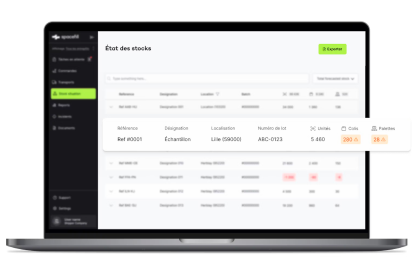
Real-time unified visibility. Spacefill connects to each site's WMS through prebuilt integrations and aggregates inventory, order status, and activity data in a single dashboard. Logistics managers get a live view of the entire network without querying individual systems or reconciling exports. Discrepancies, capacity alerts, and site-level anomalies are surfaced automatically.
Rapid site onboarding. Adding a warehouse or 3PL does not require custom development. Spacefill's integration library covers the main WMS platforms and 3PL systems. A new site can be connected in days rather than weeks, which matters for companies expanding their network or replacing an underperforming provider.
Configurable automated routing. The routing engine applies team-defined rules to every incoming order, selecting the fulfillment site based on stock, capacity, shipping cost, and delivery commitments. Rules are updated by logistics teams without engineering involvement. Manual overrides handle exceptions.
Companies using Spacefill report measurable reductions in outbound shipping cost, driven by higher rates of optimal routing, and faster response to demand spikes through dynamic load distribution across sites.
FAQ: Managing Multiple Warehouses
How do you consolidate inventory data from multiple WMS platforms?
The most reliable approach is a dedicated integration layer that connects to each WMS via API, normalizes the data to a common schema, and maintains a continuously updated unified inventory record. This is precisely what a logistics orchestration platform handles, removing the need for manual exports and scheduled batch reconciliations.
What is the difference between an OMS and a logistics orchestration platform?
An OMS routes orders based on catalog, channel, and inventory rules. A logistics orchestration platform goes deeper by ingesting real-time capacity data, site-level processing performance, and 3PL-specific constraints. The orchestration layer gives routing decisions greater operational accuracy than an OMS alone can provide.
How quickly can a new warehouse or 3PL be integrated into an existing network?
With prebuilt connectors, integration timelines drop significantly. On Spacefill, adding a new site or 3PL can be operational without custom development on the client side, which shortens the integration timeline from weeks or months to days in supported cases. The key prerequisite is that the new site's WMS or 3PL system is supported by the platform's integration library.
How do you decide how much stock to hold at each site?
Site targets combine local demand forecasts, safety stock based on demand variability and replenishment lead time, and the cost of holding inventory at that location versus shipping from another node. Tracking the inter-site transfer rate reveals whether stock distribution is aligned with actual demand geography.
What are the signs that your multi-warehouse setup needs a technology upgrade?
Key indicators include: logistics teams spending significant time consolidating stock data manually; routing decisions being made ad hoc without a defined policy; frequent stockouts at one site while another holds excess; inability to promise accurate delivery windows because stock visibility lags by hours; and growing difficulty onboarding new 3PL partners without custom development work.