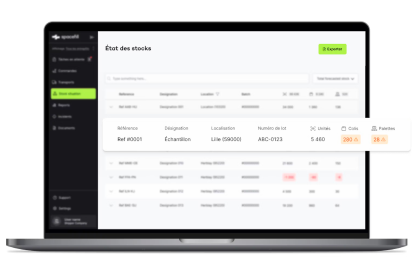
OMS, short for Order Management System, has become a central acronym in the modern e-commerce and retail technology stack. Yet it is still widely confused with other supply chain building blocks: ERP, WMS, IMS, TMS. This article provides a complete definition of the Order Management System, breaks down its core features, quantifies its concrete benefits for online retailers, and clarifies how it differs from neighboring systems.
If you are evaluating whether an OMS makes sense for your business, this guide gives you the conceptual foundation to make an informed decision. For the next step (solution selection, evaluation criteria, RFP), see our companion article "How to Choose an OMS for Your E-Commerce Business."
Definition: What Is an OMS?
An Order Management System (OMS) is a software platform that orchestrates the complete lifecycle of an order, from the moment it is placed at checkout through delivery (or return), including allocation to the right fulfillment node, picking, shipping, and tracking.
In short: an OMS is the control tower for orders. Where a CMS (Shopify, PrestaShop, WooCommerce) handles storefront and checkout, and a WMS handles physical warehouse operations, the Order Management System bridges the two. It decides which order ships from which warehouse, when, and via which carrier, and delivers a consistent delivery promise to the end customer.
A modern OMS typically covers six core capabilities:
- Multichannel order capture: aggregation of orders from the storefront, marketplaces, mobile apps, physical stores, B2B, and EDI.
- Unified inventory view: real-time visibility across all nodes (warehouses, stores, 3PLs, in-transit stock, suppliers).
- Orchestration and routing: intelligent allocation of each order to the best fulfillment point based on stock, cost, lead time, SLA, and customer priorities.
- Delivery promise: ATP (available-to-promise) calculation at checkout, surfacing a precise delivery date.
- Execution and tracking: consolidated tracking, SLA measurement, anomaly detection, and incident escalation.
- Returns and after-sales: return authorization management (RMA), stock reintegration, and refund or credit triggering.
OMS, WMS, ERP, IMS: Key Differences at a Glance
Many e-commerce operators mix up these acronyms. Here is a quick reference guide.
| System | Primary Mission | Scope | When to Adopt |
|---|---|---|---|
| OMS | Orchestrate the full order lifecycle | Multichannel capture, routing, ATP, execution, returns | As soon as you have multiple channels or multiple fulfillment nodes |
| WMS | Manage physical warehouse operations | Receiving, putaway, picking, packing, shipping | Once a warehouse handles significant volume or complexity |
| ERP | Centralize finance, procurement, HR, and sales | Accounting, purchasing, vendor management, payroll | For financial and operational consolidation |
| IMS | Manage inventory levels and valuation | Stock counting, forecasting, replenishment | For multi-site inventory control |
| TMS | Optimize transportation and shipping | Carrier selection, rate shopping, label generation | To reduce shipping costs and lead times |
WMS and OMS are the most commonly confused because both touch fulfillment operations. Their scopes are clearly separate, though: a WMS works inside the warehouse (what happens physically), while an Order Management System works above the warehouses (which order ships from where). A modern OMS integrates with one or more WMS platforms without replacing them.
The 7 Core Features of a Modern Order Management System
Beyond the definition, here is what an OMS must actually do in 2026.
1. Centralized Multichannel Order Capture
The OMS must consume order feeds from every channel: storefront (Shopify, PrestaShop, WooCommerce, Magento, custom builds), marketplaces (Amazon, eBay, Walmart, Mirakl), mobile apps, physical stores, B2B (EDI orders or self-service portal), and call centers. All orders land in a single repository with full source traceability.
2. Real-Time Unified Inventory View
The Order Management System must continuously display available stock at every node: central warehouse, regional 3PLs, stores, in-transit inventory, and supplier stock. This view feeds allocation decisions and the delivery promise.
3. Intelligent Orchestration and Routing
The OMS must allocate each order to the best fulfillment point according to configurable business rules: available stock, distance, shipping cost, contractual SLA, customer priority, and carrier capacity. The best platforms offer a no-code rules engine that lets business teams adjust logic without involving IT.
4. Dynamic Delivery Promise (ATP)
The Order Management System calculates a precise delivery date at checkout based on available stock, the shipping origin, and carrier lead times. This dynamic promise replaces the old generic "ships within 5 business days" messaging and typically increases checkout conversion by 8 to 15%, depending on the segment.
5. Consolidated Execution and Tracking
The OMS monitors the execution of every order through the WMS at the shipping node, then tracks it via the carrier all the way to delivery. It measures SLA continuously, flags anomalies (delays, blockages, losses), and routes escalations to the right teams.
6. Returns Management
The OMS drives the reverse flow: return authorization (RMA), return parcel tracking, stock reintegration, and refund or store credit triggering. The best platforms cover omnichannel returns (for example, accepting an online purchase as an in-store return).
7. Intelligence and Automation
OMS platforms in 2026 increasingly embed operational AI: conversational agents for business teams, predictive anomaly detection (likely delays, imminent stockouts), automated order entry (OCR on invoices, PDF extraction), and history-based predictive routing. Spacefill, for instance, ships 4 specialized AI agents covering assistance, anomaly detection, order entry, and routing.
Measurable Benefits of an Order Management System
A well-deployed OMS delivers concrete, measurable gains. Below are the ranges observed among Spacefill customers, which are consistent with broader market benchmarks.
Customer experience:
- +12% checkout conversion through the dynamic delivery promise displayed in the cart.
- -67% WISMO calls (Where Is My Order) thanks to consolidated tracking and proactive notifications.
- -35% logistics support tickets through upstream anomaly detection.
Internal operations:
- -80% manual tasks related to order entry and reconciliation across channels and systems.
- -50% fulfillment errors through centralized orchestration and formalized business rules.
- Near-zero oversells (orders accepted without available stock) thanks to the unified inventory view.
Financial impact:
- 3x lower TCO compared to a traditional enterprise OMS, for next-generation platforms like Spacefill at equivalent scope.
- Reduced inventory carrying costs through better allocation.
- Lower shipping costs through optimal node and carrier selection.
Who Needs an Order Management System?
Not every e-commerce business is ready for an OMS. Three profiles benefit clearly.
Profile 1: Mid-Market to Enterprise Omnichannel Retailer
You operate an online store alongside a physical retail network. You want to enable ship-from-store, click-and-collect, and in-store reservation. You manage inventory across multiple locations and need a unified view to maintain your customer promise.
Profile 2: Multi-3PL E-Commerce Operator
You ship from multiple in-house warehouses or several third-party logistics providers (3PLs). You want to orchestrate allocation, monitor provider SLAs in real time, and eliminate the manual coordination that does not scale.
Profile 3: DTC Brand Selling Across Multiple Channels and Markets
You sell on your own site, on two or three marketplaces, and across multiple markets (US, UK, EU, for example). You want to centralize orders, synchronize inventory, and deliver a consistent experience in each market.
5 Signals That You Need an OMS
If you recognize three or more of these signals, it is probably time to evaluate an Order Management System.
- Your teams manually enter or reconcile orders across channels, marketplaces, and ERP. Several days per month go to this task alone.
- You regularly experience oversells or ghost stockouts (orders accepted without actual available inventory).
- You operate multiple warehouses or 3PLs, and allocation decisions are made manually or through rigid hard-coded rules.
- Your customers receive generic delivery promises ("ships within 5 business days") and your WISMO call rate is high.
- You want to open a new channel (marketplace, B2B, physical retail) or enter a new market, and your current stack already feels fragile.
5 Common Myths About OMS
Myth 1: "My ERP already does OMS."
False in most cases. ERP OMS modules from NetSuite, SAP, or Microsoft Dynamics cover order capture and status tracking, but not retail depth (ship-from-store, advanced ATP, dynamic delivery promise) or native multi-3PL orchestration.
Myth 2: "Shopify or PrestaShop is enough as an OMS."
False once you move beyond a single channel and a single warehouse. CMS platforms handle storefront and checkout, not multi-node orchestration or advanced ATP.
Myth 3: "An OMS costs hundreds of thousands of dollars."
True for legacy enterprise platforms (Salesforce, Manhattan, IBM Sterling). False for next-generation platforms: Spacefill delivers a 3x lower TCO compared to a traditional enterprise OMS, and SMB solutions like Linnworks or Shippingbo start at a few hundred dollars per month.
Myth 4: "OMS replaces my WMS."
False for modern platforms. An OMS like Spacefill connects to the existing WMS at each 3PL without replacing it, avoiding the heavy migration burden on the provider side.
Myth 5: "An OMS is a 12-month implementation project."
True for legacy enterprise OMS. False for next-generation platforms: Spacefill deploys in 6 to 12 weeks as a standard engagement, and 4 to 6 months for multi-country rollouts.
To go further: see how an order management system (OMS) orchestrates every order, from capture to routing.
Conclusion
An OMS is the central orchestration layer of a modern e-commerce operation: it holds together multichannel order capture, intelligent allocation, the customer delivery promise, and multi-node execution. In 2026, it has become a foundational investment for any retailer that has moved beyond a single channel and a single warehouse. Next-generation platforms like Spacefill make the Order Management System accessible with controlled total cost of ownership and deployment timelines measured in weeks rather than months.
Want to see concretely how an OMS fits into your current stack and what gains it could generate for your business? Book a Spacefill demo to see the platform in real conditions and measure the ROI on your specific use case.
FAQ
What is the difference between an OMS and a WMS in one sentence?
The OMS directs the order (what ships from where, when, and via which carrier). The WMS physically executes the order inside the warehouse (picking, packing, shipping).
Is an Order Management System useful for a small e-commerce business?
Not necessarily. A small business operating a single channel and a single warehouse can manage without one. Once that business adds a channel (marketplace, B2B) or a second fulfillment node (3PL, second warehouse), a dedicated OMS becomes relevant.
What are the leading OMS platforms in 2026?
In the mid-market and enterprise segment, the key players include Spacefill (hybrid OMS plus 3PL network), OneStock (European omnichannel retail), KBRW (French enterprise and industrial), Brightpearl by Sage (UK and US retail), Linnworks (marketplace-driven), Fluent Commerce, and fabric OMS (composable). See our detailed Top 8 comparison.
How long does an OMS implementation take?
Anywhere from 2 to 4 weeks for a SMB SaaS OMS (Linnworks, Shippingbo), up to 6 to 18 months for a legacy enterprise OMS (Salesforce, OneStock multi-country). Spacefill deploys in 6 to 12 weeks as a standard engagement.
How does an OMS improve e-commerce conversion?
Primarily through the dynamic delivery promise at checkout. Showing "delivered tomorrow" with a specific date converts 8 to 15% better than a generic "ships within 5 business days." Spacefill customers measure an average of +12% checkout conversion after activation.
Does an OMS handle B2B orders?
Yes. Modern Order Management Systems (Spacefill, Cin7 Omni, Brightpearl, OneStock) cover both B2C and B2B, including large EDI orders, multi-line, multi-shipment, and payment terms. B2B is actually one of the fastest-growing use cases.